
Self-employment is booming in Pakistan as IT and IT-enabled exports hit a record $4.5 billion in FY2025-26, and freelancers alone earned over $1 billion for the first time, which is roughly a quarter of that total according to the State Bank of Pakistan. The Oxford Internet Institute now ranks Pakistan fourth in the world for online freelancing. Behind those numbers sit millions of online sellers, consultants, and small shop owners earning outside a regular job.
At some point that income needs to be official. Clients ask for an NTN before they pay, banks want a business account, and non-filers end up paying higher withholding tax on bank transactions, property, and vehicles. Registering as a sole proprietor fixes all of this in one step, and it is the cheapest and fastest way to run a legal business in Pakistan. You register yourself with the Federal Board of Revenue (FBR), get a National Tax Number (NTN), and that is it: no company, no SECP, no partners.
This guide walks you through who can register, the documents you need, the exact FBR IRIS steps, the cost, how you are taxed, and what to do afterward. If you prefer professional assistance, you can also use our sole proprietorship registration services in Pakistan to get your registration done correctly the first time.
What Is a Sole Proprietorship In Pakistan?
A sole proprietorship in Pakistan is the simplest business structure you can start. Here is what it means and how it differs from a private limited company.
A sole proprietorship is a business owned and run by one person, which means you and your business are the same in the eyes of the law, so you keep all the profit and carry all the liability. There is no separate legal entity, which means your personal assets can be used to settle business debts, and this is known as unlimited liability.
It needs no SECP registration, only an NTN from the FBR, because SECP registers companies such as private limited companies rather than sole proprietorships. That is what makes this the simp
Is Sole Proprietorship Registration Mandatory In Pakistan?
Under Pakistani law, registering a sole proprietorship is not strictly mandatory for all small businesses. Many individuals can operate under their own name without formal registration. However, registration becomes compulsory when a business intends to engage in formal contracts, open a business bank account, or register for tax purposes with the Federal Board of Revenue (FBR).
Operating informally without registration carries risks. For example, the owner cannot legally enforce contracts in their business name, may face challenges in obtaining credit or loans, and could encounter penalties for non-compliance if the business grows or becomes taxable. Registration adds legitimacy and legal protection while reducing potential operational risks.
Who Can Register a Sole Proprietorship In Pakistan?
Any Pakistani citizen with a valid CNIC can register as a sole proprietor in Pakistan and run the business independently. There is no minimum capital requirement or general professional qualification. You can also hire staff or involve family members in the business. Foreign nationals can also register if they meet the applicable requirements and have a passport with the required legal documents instead of a CNIC.
| Criteria | Requirement |
| Minimum age | 18 years or older |
| Pakistani citizens | Valid CNIC |
| Foreign nationals | Valid passport plus visa or work permit |
| Owner type | One individual only (no companies or partnerships) |
| Minimum capital | None |
| Qualification | None required |
| Hiring | Allowed, including family members |
Benefits of Registering a Sole Proprietorship In Pakistan:
The benefits of registering a sole proprietorship in Pakistan are especially useful for people who work on their own. The process is simple and gives you several benefits without much paperwork. Here are the main benefits.
- Free to register, with no government fee for the NTN.
- Fast, since the application takes 10 to 15 minutes and the NTN is issued within 24 to 48 hours.
- Minimal paperwork, with no Memorandum or Articles of Association.
- Full profit, meaning you keep everything the business earns after tax.
- Simple filing, just one annual return as an individual.
- Filer status on the Active Taxpayer List (ATL), which cuts your withholding tax.
The trade-off is unlimited personal liability and harder access to large investments, though for most freelancers and small businesses that rarely bites in the early years.
Documents Required for Sole Proprietorship in Pakistan
The paperwork for sole proprietorship registration is short, so gather these before you start on the FBR IRIS portal and the process moves fast.
- Valid CNIC
- Mobile SIM registered in your own name
- Personal email address
- Proof of business address (a recent utility bill)
- Rent agreement or ownership deed
- Business name
- Bank account details
You do not need Articles of Association, a Memorandum, or a work visa, foreign nationals aside. Every detail must match your CNIC and NADRA records, since mismatches are the top reason applications get rejected.
How to Register a Sole Proprietorship In Pakistan?
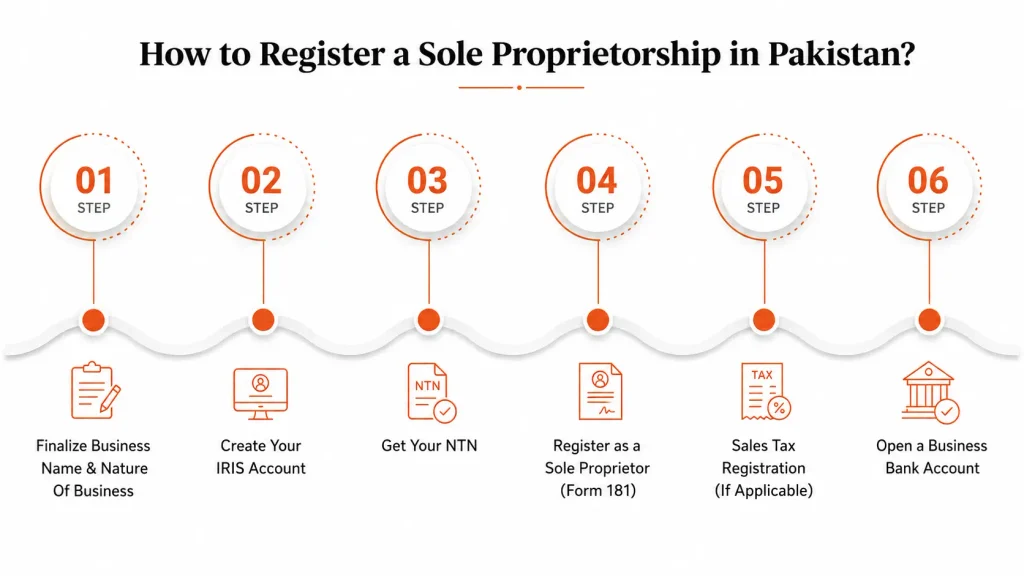
You can register a sole proprietorship in Pakistan entirely online in one sitting. Here are the six steps on the FBR IRIS portal from start to finish.
Step 1: Finalize Business Name and Nature Of Business:
Choose a business name that is unique, professional, and follows Pakistani naming rules, avoiding anything already in use, misleading, or infringing on intellectual property. It is also important to define what your business does, as stating clearly whether you are trading, consulting, or offering services keeps your registration accurate and your tax obligations correct.
Step 2: Create Your IRIS Account:
Go to iris.fbr.gov.pk, select “Registration for Unregistered Person,” and enter your CNIC, mobile number, and email before submitting. IRIS then sends one verification code to your mobile and another to your email, and once you enter both to confirm your identity you can set the password you will use for every step that follows.
Step 3: Get Your NTN
Once your account is created, your National Tax Number is issued in your own name at no cost, and there is nothing extra to apply for because for an individual your CNIC number itself becomes your NTN, which means you are now a registered taxpayer.
Step 4: Register as a Sole Proprietor (Form 181):
Log in to IRIS and open Form 181, then add your business name, address, nature of activity, and the date you started trading. Submitting this form links the business to your NTN and formally makes you a registered sole proprietor, turning your personal NTN into a business registration.
Step 5: Sales Tax Registration (If Applicable):
Most freelancers and small sellers can skip this, since you need a Sales Tax Registration Number (STRN) only if you deal in goods and cross PKR 10 million in annual turnover, or if you are a manufacturer, importer, or Tier-1 retailer. Service providers register with their provincial authority instead, which is SRB in Sindh, PRA in Punjab, KPRA in Khyber Pakhtunkhwa, and BRA in Balochistan.
Step 6: Open a Business Bank Account:
Take your NTN certificate and CNIC to your bank and open a current account in your business name, and because banks ask for the NTN certificate as proof the business is registered, make sure you complete Step 3 first. This account is what clients pay into and what you use for all business transactions.
Sole Proprietorship Registration Fee In Pakistan:
The fee to register a sole proprietorship in Pakistan is low, and the NTN itself is free. The only real expense is a consultant fee, and paying it means you never have to worry about missing documentation or getting the submission wrong. Company Enrolla can register your sole proprietorship and manage the entire process on your behalf, allowing you to bypass the FBR portal completely.
| Item | Cost (PKR) |
| NTN registration (FBR) | Free |
| Letterhead and business stamp | 500 to 2,000 |
| Bank account opening deposit | Varies by bank |
| Trade licence or permits (if needed) | 1,000 to 10,000 |
| Consultant fee (optional) | 5,000 to 10,000 |
Other Requirements to Set Up a Sole Proprietorship in Pakistan
Beyond the NTN, setting up a sole proprietorship in Pakistan can involve a few extras based on your business. Check which of these apply to you.
- Business bank account to separate personal and business money and take client payments.
- Business stamp and letterhead for invoices and contracts.
- Trade licence from your municipal or cantonment authority if you run a physical shop.
- Chamber of Commerce membership for import, export, or government tenders.
- PSEB registration for freelancers and IT exporters, which unlocks a lower tax rate (see below).
How Is a Sole Proprietorship Taxed in Pakistan?
A sole proprietor is taxed as an individual on non-salaried business slabs, not at any corporate rate. Tax applies to your net business income, which is your receipts minus allowable expenses like rent, utilities, and salaries. Income up to PKR 600,000 a year is tax-free. Above that, rates run from 15% to 45% under the Finance Act 2026.
| Annual Taxable Income (PKR) | Tax |
| Up to 600,000 | 0% |
| 600,001 to 1,200,000 | 15% of the amount above 600,000 |
| 1,200,001 to 1,600,000 | Rs 90,000 + 20% above 1,200,000 |
| 1,600,001 to 3,200,000 | Rs 170,000 + 30% above 1,600,000 |
| 3,200,001 to 5,600,000 | Rs 650,000 + 40% above 3,200,000 |
| Above 5,600,000 | Rs 1,610,000 + 45% above 5,600,000 |
Two more points:
- Sales tax of 18% applies only if you hold an STRN.
- IT and freelance service exports are taxed under a final tax regime (Section 154A) at just 0.25% if you register with the PSEB, or 1% if you do not. This alone makes PSEB registration worth it for exporters.
- Sales tax compliance (if registered): Businesses registered for sales tax must submit monthly or quarterly sales tax returns, depending on federal or provincial requirements.
- Withholding tax considerations: Certain payments made to suppliers or contractors may be subject to withholding tax, which must be deducted and submitted to the FBR on time.
Sole Proprietorship vs Other Business Structures in Pakistan:
A sole proprietorship is not your only option. Before you register, it helps to see how it compares with a partnership and a private limited company, so you pick the structure that fits your goals.
| Factor | Sole Proprietorship | Partnership (AOP) | Private Limited Company |
|---|---|---|---|
| Registered with | FBR (NTN only) | Registrar of Firms and FBR | SECP and FBR |
| Owners | One person | 2 or more partners | 2 to 50 shareholders |
| Legal status | Same as the owner | Same as the partners | Separate legal entity |
| Liability | Unlimited, personal | Unlimited, shared | Limited to shares |
| Minimum capital | None | None | No legal minimum |
| Setup time | 1 to 2 days | 3 to 7 days | 14 to 21 days |
| Setup cost | Free (NTN only) | Low | Moderate (SECP fees) |
| Taxed as | Individual, 15 to 45% | AOP slabs, 15 to 45% | Company, 29% |
| Annual audit | Not required | Not required | Required |
| Best for | Freelancers, solo earners | Small joint ventures | Scalable startups seeking investment |
- Choose a sole proprietorship if you are a freelancer, consultant, or small business owner who wants to start fast and cheap, and you are comfortable carrying the liability yourself.
- Choose a partnership (AOP) if two or more people run the business together and want to share ownership and profit without forming a company.
- Choose a private limited company if you plan to raise investment, take on bigger clients, or shield your personal assets with limited liability. It costs more and takes longer, but it scales.
For most people starting out, the sole proprietorship is the natural first step. You can always convert to a company later as your business grows.
Compliance After Establishing a Sole Proprietorship in Pakistan:
Establishing a sole proprietorship in Pakistan is a one-time job, but staying compliant is ongoing. These few tasks keep you a filer in good standing.
- File your annual income tax return by 30 September to stay on the ATL.
- File monthly sales tax returns by the 18th if you hold an STRN.
- Keep records and invoices for at least 5 years.
- Your NTN never expires, so there is no renewal.
Industry-Specific Licensing Requirements:
The NTN covers your core sole proprietorship registration in pakistan, but some industries need an extra licence on top. Setting up a sole proprietorship in Pakistan in these fields means one more step.
- Food and catering: registration with your provincial food authority, plus health and hygiene clearance.
- Retail and wholesale shops: a municipal trade licence from your local council, renewed each year.
- IT and software exporters: optional PSEB registration, which unlocks the lower export tax rate.
- Professional services: the licence for your field, such as ICAP for accountants, the Pakistan Bar Council for lawyers, or PMDC for doctors.
- Import and export: Importer Exporter registration through the Pakistan Single Window (PSW).
- Manufacturing: environmental approval from the EPA and standards certification from PSQCA.
If your field is not listed here, a quick check with your local Chamber of Commerce confirms what you need.
How to Open a Sole Proprietorship Bank Account in Pakistan?
Once your NTN is issued, a business bank account is the next move. It keeps your finances clean and lets clients pay your sole proprietorship in Pakistan properly.
- Pick a bank. All major banks, including HBL, UBL, MCB, Meezan, and Bank Alfalah, offer sole proprietor current accounts.
- Gather your documents: your CNIC, NTN certificate, business letterhead, and proof of business address.
- Fill the account opening form with your personal details, business details, and NTN.
- Complete verification. You visit the branch once in person, and some banks make a quick check of your premises.
- Wait for activation, which takes 2 to 7 working days. You then receive your account number, chequebook, and debit card.
A few tips: most banks ask for a minimum balance of PKR 5,000 to 50,000. If you bill overseas clients, pick a bank that supports SWIFT transfers. For Riba-free banking, Meezan and other Islamic windows offer Shariah-compliant current accounts.
How Company Enrolla Helps You Register Your Sole Proprietorship?
Now that you know how to register a sole proprietorship in Pakistan, you might decide you would rather not do it yourself. Not everyone wants to spend time on the FBR portal and chase paperwork, so Company Enrolla steps in and handles the whole process for you, from start to finish.
Our team handles the full process:
- NTN registration and IRIS enrollment in your name
- Business registration through Form 181
- Document preparation, including your letterhead and business stamp
- Sales tax (STRN) registration if your business needs it
- Help opening your business bank account
- Clear guidance on staying a filer and meeting your deadlines
You focus on running your business, and we take care of the compliance so everything is done right the first time.
FAQs:
Is Sole Proprietorship Registration Free In Pakistan?
Yes, registering a sole proprietorship is completely free. The NTN you get from the FBR through the IRIS portal carries no government fee at all. The only time you pay is if you hire a tax consultant to handle it for you, which usually costs between PKR 5,000 and 10,000. Doing it yourself costs nothing beyond a letterhead and stamp.
How Long Does Sole Proprietorship Registration Take In Pakistan?
If you want to register as a sole proprietor in Pakistan, the core FBR registration is relatively quick. Completing the online form on the FBR IRIS portal can take around 10 to 15 minutes, provided you have all the required information and documents ready. Once submitted and verified, your NTN registration is generally processed within 24 to 48 hours. If you also need a business bank account, trade licence, or other local registration, those steps may take additional time.
Do I Need SECP Registration For a Sole Proprietorship In Pakistan?
No, those documents are not required for a sole proprietorship. A Memorandum of Association and Articles of Association apply only to companies registered with SECP, where they set out the company’s rules and structure. As a sole proprietor, you and your business are the same legal person, so a simple NTN from the FBR is all you need.
Do I Need Articles of Association Or a Memorandum For a Sole Proprietorship?
Yes. In Pakistan, there is no separate certificate for a sole proprietorship. Your NTN certificate from the FBR is your official proof of registration, and it shows your name, your unique NTN, and your business details. You can use it to open a business bank account, register for sales tax if needed, sign contracts, and apply for government tenders.
What Tax Rate Does a Sole Proprietor Pay In Pakistan?
You are taxed as an individual, not as a company. Your net business income, meaning your earnings minus expenses, is taxed on the non-salaried slabs. Income up to PKR 600,000 a year is completely tax-free, and above that the rate rises in steps from 15% to a maximum of 45%. IT and freelance export income is taxed separately at just 0.25% to 1%.
Can I Convert My Sole Proprietorship Into a Company Later?
Yes, and many growing businesses do exactly that. When you are ready to scale, you can register a private limited company with SECP, then transfer your business assets and update your tax records with the FBR. This gives you limited liability and easier access to investment, and the process usually takes around 14 to 21 days once your documents are ready.
Can a Sole Proprietor Hire Employees In Pakistan?
Yes. A sole proprietor in Pakistan can hire as many employees as the business needs, with no legal limit and no change to your business structure. You will take on some employer duties, such as deducting withholding tax from taxable salaries and registering with EOBI and provincial social security once you cross the required number of employees. Hiring staff does not affect your ownership or your status as a sole proprietor.
Does a Sole Proprietorship Need a Physical Office Address In Pakistan?
Not necessarily. A sole proprietorship in Pakistan needs a valid business address for registration, but it does not have to be a commercial office. You can use your home address, and many freelancers and online sellers do exactly that. The key requirement is proof of address, usually a recent utility bill along with a rent agreement or ownership deed. As long as the address is genuine and the documents match your records, the FBR accepts it.